

25/09/2025
Shopping cart is empty.


Ngõ 177, Cụm công nghiệp An Tràng, Xã An Lão, Thành phố Hải Phòng
 0
0

Powder coating is a dry finishing process that involves the application of fine, electrostatically charged powder particles to a substrate's surface. This application method ensures an even and consistent coating, free from drips, sags, or unevenness.
Before applying the powder, the substrate must undergo thorough cleaning to remove any contaminants like oil, grease, or rust. This crucial step ensures proper adhesion and a flawless finish. The substrate is freed from dust, scale, rust, grease, dirt, and any oxide layers (for example on aluminum). There exist chemical and mechanical pre-treatment processes. To increase the corrosion protection and improve the adhesion of the powder coating a conversion layer is created on the piece during the pre-treatment. Following this, the workpiece must dry completely.
Cleaning Methods: The cleaning process involves the use of weak alkali and neutral detergents, often in dip tanks or wash stations. These stations are equipped to spray parts with hot water, steam, detergents, and other pretreatment solutions to clean and chemically prepare the surface before coating. They ensure a spotless foundation for your powder coating.
Masking Methods for Precise Applications: Sometimes, parts require specific areas to remain uncoated. This is where masking products like masking dots come into play. They're available in various shapes and forms, generally constructed of paper or plastic film coated with a pressure-sensitive adhesive. These nifty tools adhere to the substrate, safeguarding the covered areas from meeting the powder material during the coating process.
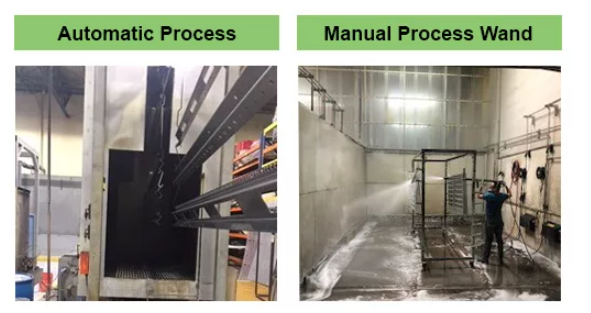
The Role of Chemical Pretreatment: Chemical pretreatment involves the use of chemicals to clean the surface, which promotes adhesion of the powder coating to adhere on slick or difficult metals. This process is typically carried out using a series of spray nozzles or an alkaline immersion dip. Parts undergo multiple stages to ensure optimal surface preparation. Chemical pretreatment processes can either be automatic comprising of a conveyer line with multiple stages or manual operated using spray parts with wands or hoses.
First, the substrates are cleaned using an alkaline, acidic, or neutral cleaner (generally alkaline). Following this, parts are surface treated with a conversion coating, after which an acid etches the surface to prepare it for subsequent operations. The specific type of conversion coating can vary based on the material being coated and the desired properties of the final product. A rinse stage is typically included between each pretreatment stage to remove any residual chemicals and contaminants. Lastly, a RO (Reverse Osmosis) or DI (Deionization) Rinse is applied to improve coating performance and reduce pretreatment chemical usage. It is important to note however that this rinse shouldn’t contain any chlorides or fluorides to prevent further chemical contamination.
Mechanical Pretreatment for Tough Contaminants: Mechanical pretreatment involves the use of abrasive media which essentially means rubbing or grinding to polish or clean a substrate. For certain applications where inorganic contaminants like rust, mill scale, and laser oxide need removal, this pretreatment method is preferred. Techniques like sand or shot blasting use high-velocity air to drive abrasive materials (like sand, grit, or steel shot) toward the substrate.
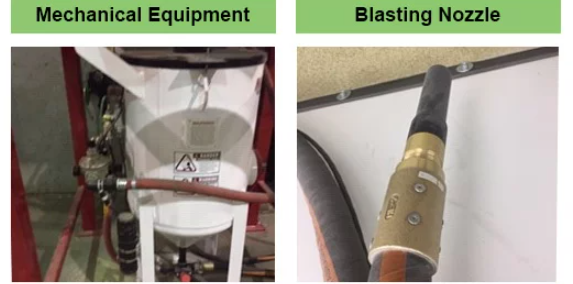
This creates an anchor pattern on the part's surface, significantly improving the adhesion of the powder coating to the substrate. Several different types of abrasives are available, and their use depends on the type of finish and contaminant to be removed. For instance, Walnut shells would be used for de-burring while plastic grit will be used to remove paint. Similarly, glass beads are preferred if the end goal is to get a matte and satin finish. Mechanical cleaning can be used independently or alongside a chemical treatment. While it enhances adhesion, it does not offer additional corrosion protection. In many cases, after mechanical blasting, the surface is coated with a suitable primer to add extra corrosion protection. The primer may also incorporate zinc-containing materials for further enhancements.
The type of substrate you use can have a major influence on the pre-treatment process you follow.
Based on your project’s needs and the size of your business, there are a wide range of different powder application options to choose from. But generally, for the most part, there are two primary methods used across the industry: Electrostatic deposition (ESD) and fluidized bed powder coating.
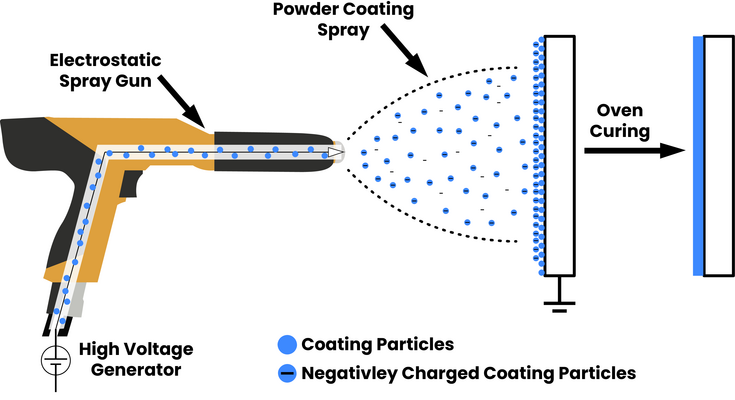
ESD is the more common of the two methods, particularly for coating metal parts. The powder is applied using a spray gun, creating an electrostatic charge that draws the particles to the grounded substrate. This attraction results in a uniform and efficient coating. It is essential to avoid the entry of dust and dirt at this step. The powder spray gun creates a charged cloud of powder. As a result, the paint particles adhere electrostatically to the piece and form a layer.
A typical manual setup of this application process involves the following components:
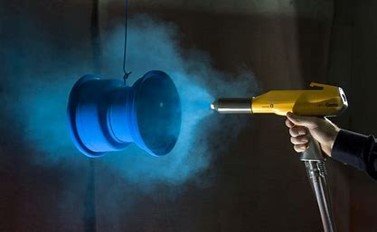
Spray systems are pivotal in the powder application process, offering efficient and precise coating application across various surfaces and part geometries. Spray systems in powder coating include components such as the powder hopper for holding the coating materials, an application gun for spraying, a feed system for transporting the powder from the hopper to the gun, a control unit that regulates and fine-tunes various application parameters, as well as air-supply and recovery systems. So, what makes a good powder coating spraying system? Let’s find out!
A notable characteristic of effective spray systems lies in their field-serviceable design and utilization of quick-turn components. This strategic approach simplifies maintenance procedures, leading to reduced downtime and ensuring a continuous, reliable performance throughout various coating tasks. When considering spray systems focus on adaptability as well and choose ones with versatile configurations, as they offer flexibility to cater to diverse coating requirements. An innovative pump design is another important consideration as it further enhances the functionality of the overall system by optimizing energy consumption, contributing to both efficiency and sustainability in coating processes.
Lastly, all-digital control units are becoming more common, providing precise control over electrostatic and pneumatic settings. This level of control is crucial in achieving optimal coating performance, ultimately leading to the production of high-quality finished products.
In contrast, fluidized bed powder coating is somewhat different. Here's how it works:
Employing oscillators, reciprocators, and robots to manage spray equipment offers cost savings and ensures consistent coverage in numerous applications. Gun triggering, which involves automatically turning the spray gun on and off based on part positioning, reduces overspray, leading to reduced material consumption.
Tin liên quan

31/01/2026
NewsClosing One Year – Opening a New Journey
View more
20/10/2025
NewsAlways be a "bright flower" that shines in life and at work.
View more
07/10/2025
NewsMid-Autumn Reunion – Lasting Connection – Radiant Success!
View more
06/09/2025
NewsWith the motto "Health is the most valuable asset"
View more


